
Roofing a Queen Anne or Painted Lady Home: One Roof, Many Textures
Roofing a Queen Anne or Painted Lady Home: One Roof, Many Textures
Part of our series on roofing America’s classic home styles.
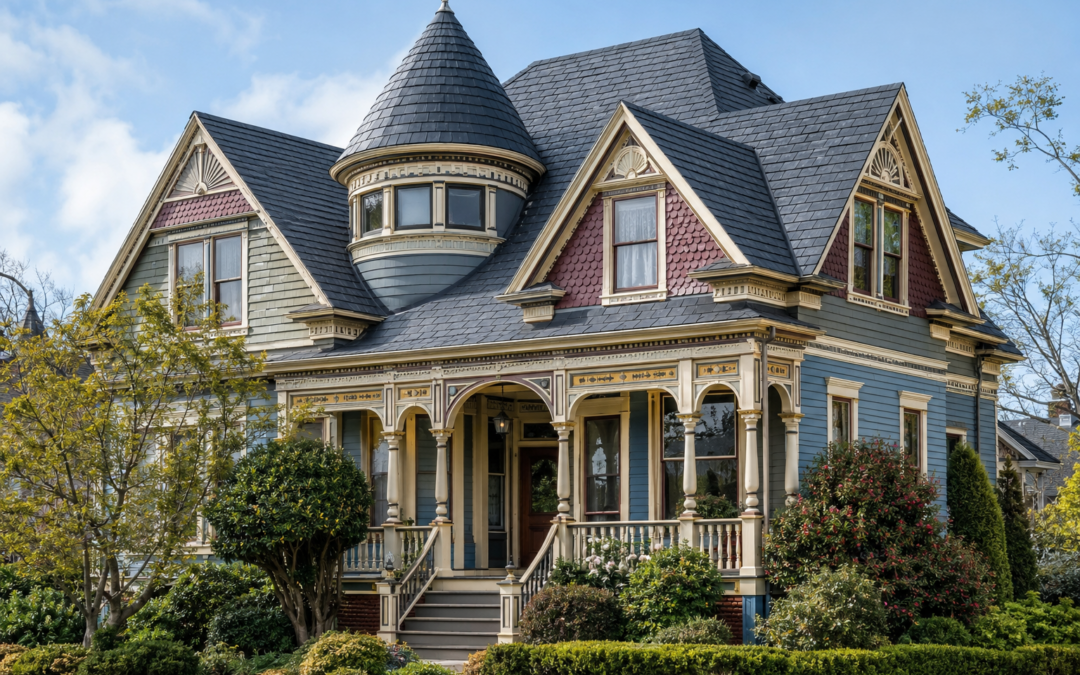
A Queen Anne home does not whisper. It is the most exuberant of the Victorian styles: a steep, busy roofline, a round tower capped with a conical roof, front-facing gables filled with fish-scale shingles, and a paint scheme bold enough to earn the nickname “Painted Lady.” Every part of the house is doing something, and the roof is doing the most. That is what makes it spectacular, and it is also what makes it a challenge to replace.
If you own a Queen Anne or Painted Lady in the Lafayette area, you already know the roof is more than shelter. It is the crown of an elaborate composition, mixing materials, textures, and colors the way few other home styles ever did. So when it starts to fail, the question is not just how to stop the leaks. It is how to do that without flattening everything that makes the house special.
The problem with an aging Queen Anne roof
These homes were mostly built between 1880 and 1910, and their roofs are architecturally complex. A Queen Anne typically combines several roof planes, a turret with a conical or bell-shaped cap, multiple gables, dormers, and a tangle of valleys where they all meet. Every one of those transitions is a place where water wants in, and on a roof this intricate, there are a lot of them.
The materials are aging on two fronts at once. Many Queen Annes wore a slate main roof with decorative wood shingles in the gables and tower, and both are now well past a century old. The slate suffers from rusting nails that lose their grip (roofers call it “nail sickness”), cracked tiles, and failing flashing in all those valleys. The wood shingles rot, curl, and split. You are not maintaining one roofing system; you are maintaining two, each with its own way of wearing out.
Then there is the cost of doing it the traditional way. Genuine slate and ornamental wood shingles are both expensive, and the craftspeople who can install either one correctly are increasingly rare and pricey. Slate is heavy and brittle, a real concern on an old structure, and it cracks underfoot, so every repair is delicate. Hardest of all is matching the original look years later: the specific slate color, the shingle pattern, the multi-color scheme. Quarries close, shades drift, and recreating that mix becomes its own expensive puzzle.
Faced with all that, many owners give up and re-roof in plain asphalt. It stops the leaks and creates a different loss. A flat, single-texture asphalt roof on a Queen Anne erases the layered, decorative quality that the whole house was built around. On a style this ornate, asphalt does not read as a compromise. It reads as a mistake, and it undermines the home’s character and value.
A better option: Brava slate and shake together
This is where composite roofing solves the problem in a way that is almost tailor-made for a Queen Anne. Brava makes both Old World Slate and Composite Cedar Shake, molded from the real materials, which means you can recreate the home’s signature mix of textures as one coordinated system from a single manufacturer: slate across the main roof, shake or shingle texture in the gables and turret, all designed to work and weather together. That coordination is difficult and costly to achieve with natural materials and easy to get wrong. With Brava, it is built in.
The rest of what Brava brings fits an old, elaborate home just as well.
It is lightweight. Brava weighs a fraction of what natural slate does, so most homes can carry it with no structural reinforcement, which is kind to a century-old frame already supporting a complicated roof.
It is durable and backed by a written warranty. Brava carries a 50-year limited warranty, comes in fire-rated assemblies, and is engineered to resist impact and high winds, the kind of hail and storm punishment Indiana hands out every spring. It will not rot, curl, crack, or shed the way the original materials do.
It recreates the color, including the bold ones. This is the part that matters most for a Painted Lady. Brava can be blended to custom colors, and the color is cast through the full thickness of every tile, so you can match or recreate a polychrome scheme without it fading off the surface over time. The roof becomes part of the color story rather than a flat afterthought.
It does not depend on a vanishing trade. Both Brava lines install with standard methods by a qualified roofing crew, so you are not hunting for separate slate and ornamental-shingle specialists or paying a premium for each.
Why it fits the style
Queen Anne architecture is built on two ideas: mix your textures and use bold color to show off the detail. Those are precisely the two things Brava’s slate and shake lines, plus custom color blending, are able to deliver, and now they can be delivered on a roof actually built to last. You get the layered, decorative, colorful look the house was designed for, without betting it on materials that struggle to keep up.
If your home sits in a designated historic district, it is worth confirming any local rules about roofing materials before you commit. Many boards accept high-quality composite, and we are glad to help you determine where your property stands in the conversation.
Why the installer matters as much as the material
On a roof this intricate, the details decide everything. The way a turret cone is shingled, how the valleys are flashed, the clean transitions between slate and shake, and the finishing around dormers and gables: that is craftsmanship, and it is where a Queen Anne roof succeeds or fails. As a certified Brava installer, Wabash Valley Exteriors is trained to install Brava in accordance with the manufacturer’s specifications, which also keeps your 50-year warranty valid. We are a family-owned company serving Lafayette, West Lafayette, and the surrounding Tippecanoe County area since 2017, and we also handle storm damage and insurance claims.
Your Painted Lady was built to be looked at. Its roof can live up to the rest of it.
Ready to see Brava in your home? Request a free, no-obligation estimate or call (765) 838-0882. We will inspect your roof, walk through how slate and shake can work together on your home, and show you how to keep your Queen Anne looking like itself for the next fifty years.