

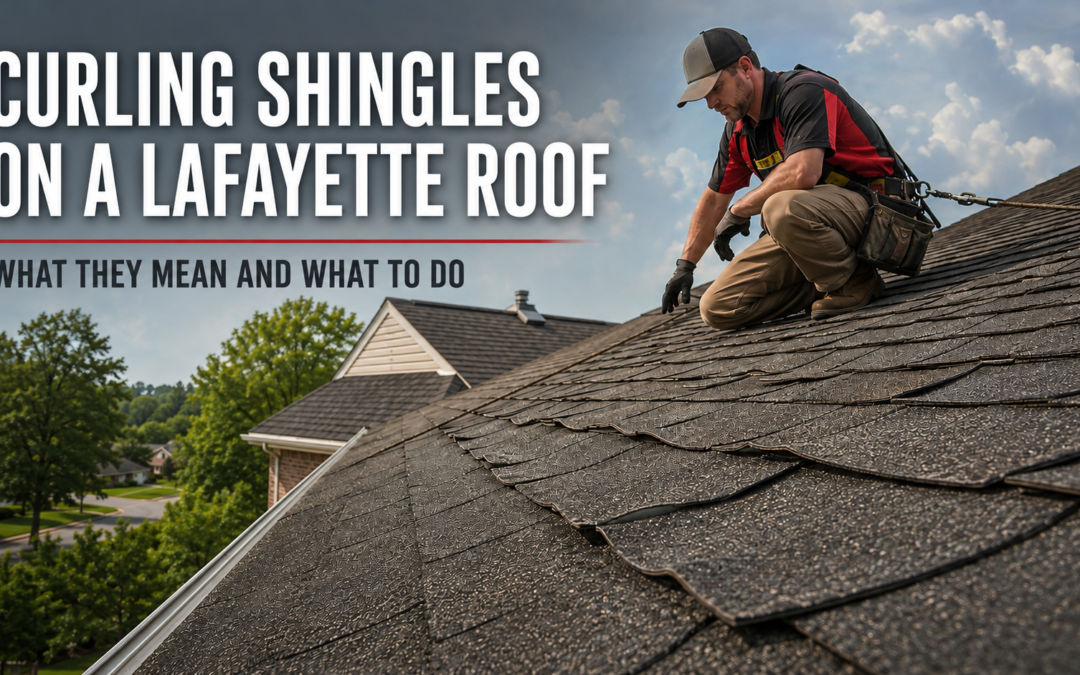
Curling Shingles on a Lafayette Roof: What They Mean and What to Do
By late August, an Indiana roof has taken about as much abuse as a year can hand it. Weeks of direct sun, humidity that never quite breaks, and afternoon storms that soak everything and then bake it dry again. That combination shows up in a specific way on asphalt shingles: the edges lift, the corners turn up, and the flat surface of the roof starts to look textured from the driveway.
Curling shingles are worth paying attention to. They are not a cosmetic problem that can wait indefinitely, and they are also not an automatic emergency. What they tell you depends almost entirely on how old the roof is and which direction the curl is going.
The Two Kinds of Curl, and Why the Difference Matters
Roofers separate curling into two patterns, and they point to different problems.
Cupping is when the edges of a shingle turn upward and the center stays low, so the shingle takes on a shallow bowl shape. This usually comes from heat and moisture underneath, not from age alone. Trapped attic heat cooks the shingle from the back side while the sun works on the front, and the material dries out unevenly.
Clawing is the opposite shape. The center of the shingle bulges up while the edges stay put, or the tabs curl down toward the roof deck. Clawing is more often a straightforward aging signal. The asphalt in the shingle has grown brittle, it has started shrinking against the fiberglass mat underneath, and the layers are no longer moving together.
Standing on the ground with binoculars, most people can tell the two apart. That one observation narrows the diagnosis considerably before anyone gets on a ladder.
What Actually Causes It
Age. Every asphalt shingle eventually loses the oils that keep it flexible. A roof past the twelve-year mark that has started to curl is behaving normally for its age. It is not defective, it is finishing its service life.
Poor attic ventilation. This is the cause we find most often on Lafayette-area homes where the shingles are still relatively young. When an attic cannot exhaust hot air, summer temperatures up there can climb far past what the roof surface itself sees. The shingles get heated from both sides at once and age at double speed. We wrote more about how this works in our post on attic ventilation and Indiana summer heat, and it is the single most common reason a ten-year-old roof looks twenty.
Roofing over an existing layer. Adding new shingles on top of old ones is legal in Indiana and it is cheaper up front. It also traps heat and moisture between the layers, and it means the new shingles are lying on an uneven surface instead of a flat deck. Curling on a layover roof often starts years earlier than it would have otherwise.
Moisture from below. A bathroom fan venting into the attic instead of through the roof, a small unnoticed leak, or humid air moving up from a damp crawlspace will all push moisture into the underside of the deck. That moisture has to go somewhere, and it works on the shingles.
Installation problems. Nails driven too high, too low, or at an angle let the shingle move. Over a few seasons of expansion and contraction, that movement turns into a lifted edge.
Why It Is Worth Addressing Before Winter
A flat shingle is a sealed shingle. Once an edge lifts, three things change.
Wind gets underneath. A curled tab gives a gust something to grab, and Indiana gets plenty of straight-line wind between now and spring. Shingles that would have ridden out a storm start tearing off instead.
Rain gets underneath. Wind-driven rain pushes sideways under lifted edges and lands on the underlayment. Underlayment is a backup layer, not a roof, and it is not designed to handle water week after week. Given enough time, that water reaches the deck.
Ice gets a foothold. This is the Indiana-specific concern. Curled edges hold snow and slush instead of shedding it, and refreezing water works its way further into the gaps. Any curling you can see in August will be worse in February.
Repair or Replace?
The honest answer depends on how much of the roof is affected and how old it is.
If curling is limited to one slope or a small patch, and the roof is otherwise sound, targeted repair makes sense. A handful of shingles can be replaced and blended in, especially if there are leftover bundles from the original installation. It is also worth asking why that one area curled while the rest did not, because the answer is usually a ventilation dead spot or a spot where water sits.
If roughly ten to fifteen percent of the roof shows curling, the picture changes. At that point the deterioration is general rather than local, and spot repairs turn into a recurring expense that never quite gets ahead of the problem. Most roofs in that condition are better served by replacement.
Age is the other deciding factor. Curling on a roof under twelve years old is a signal to investigate, because something is wrong that repair alone will not fix. Curling on a roof past twenty is simply the roof telling you where it is in its life.
One thing worth knowing before you get quotes: if ventilation caused the problem, replacing the shingles without correcting the airflow will produce the same result on the new roof. Any contractor who inspects a curling roof should be looking at the soffit vents and ridge vent, not just the shingles.
Getting a Straight Answer
A roof inspection for curling should include the attic. From inside, we can see whether the deck is damp, whether insulation is blocking the soffit vents, and whether there is enough exhaust at the ridge. From outside, we are checking how widespread the curl is, whether the granule loss matches it, and whether the deck feels solid underfoot.
That combination tells you whether you are looking at a repair, a ventilation correction, or a replacement. If you are gathering quotes from more than one company, our guide on comparing roofing estimates in Lafayette covers what should appear on each one so you can line them up fairly.
Frequently Asked Questions
Can I flatten curled shingles myself? Pressing them down or gluing the edges will not hold. The curl comes from the material itself changing shape, so the shingle returns to its curled position within a season. Roofing cement on lifted tabs can buy a few months in an emergency, but it is a stopgap, not a repair.
Do curling shingles always mean the roof leaks? No. Many curled roofs are not leaking yet, because the underlayment is still doing its job. The concern is that curling removes the roof's first line of defense, so a leak becomes much more likely during the next heavy wind-driven rain or ice event.
Will insurance cover curling shingles? Usually not on its own. Homeowners policies cover sudden damage from a specific event, such as hail or wind, rather than gradual wear. If a storm tore off shingles that were already curling, that damage may be covered even though the underlying condition is not. Our storm damage roof repair page explains how those claims typically work.
How fast do curling shingles get worse? Faster than most people expect, because the problem compounds. Each lifted edge lets in more heat and moisture, which lifts the next one. A roof with light curling in August often looks noticeably worse by the following spring after a winter of freeze and thaw.
Take a Look Before the Weather Turns
Late summer is the right time to check. The roof is dry, the days are long, and there is still room in the schedule before fall gets busy. Walk the perimeter of your house and look up at each slope with the sun behind you, which makes lifted edges much easier to spot.
If you see curling and want to know what it means for your specific roof, we will come out and look. Wabash Valley Exteriors has been working on roofs in Lafayette, West Lafayette, and the surrounding communities since 2017, and an inspection costs you nothing. Request a free estimate or call us at (765) 838-0882.